Custom-Coded Websites Win in 2026
Why custom-coded websites win in 2026 for local businesses: faster pages, cleaner structure for search, and a site you actually own instead of a template.

The Template Era Is Over: Why It’s Time to Move On
Let’s cut to the chase — local businesses have long been told a simple story: “Just pick a template, drag and drop some blocks, and your website will be ready in 20 minutes.” Platforms like Wix, Squarespace, and WordPress page builders popularized this no-code revolution and made website creation accessible to anyone.
And for many, it worked. For a while.
A template website often looks like the dentist down the street, the plumber two towns over, and thousands of other businesses on the same theme. You’re blending in, not standing out.
Fast forward to 2026. Google’s algorithm is smarter, faster, and more ruthless than ever. Your customers expect lightning-fast load times, flawless mobile experiences, and personalized interactions. Meanwhile, your competitors—those who are actually growing—have figured out something game-changing:
Custom-coded web applications aren’t a luxury anymore. They’re the new baseline for success.
This comprehensive guide will unpack why custom-coded websites differ from template builders in 2026, and what that difference means for a local business site. Ready to future-proof your digital presence? Let’s dive in.
What Is a Custom-Coded Website? Demystifying the Tech
Before we get into the nitty-gritty, let’s define what we mean by “custom-coded website” (or web app).
A custom-coded website is built from the ground up with actual programming languages and frameworks. This means using:
- HTML for the structure
- CSS for styling and layout
- JavaScript/TypeScript for interactivity
- Modern frameworks like React, Next.js, or Vue.js for dynamic, scalable front-end experiences
- Backend technologies like Node.js, Express, or serverless functions for complex logic and integrations
There’s no template, no drag-and-drop builder, no pre-packaged theme. Every line of code is written specifically for your business goals, customer journey, and brand identity.
The Tailored Suit Analogy: Template vs Custom Code
Think of it like this:
- Template website = Buying a suit off the rack. It fits okay. Everyone else has it. You might look decent, but you don’t stand out.
- Custom-coded website = Having a tailor craft a suit specifically for your body, style, and occasion. Perfect fit. Unique design. Makes you feel confident.
This analogy isn’t just about looks. It affects site speed, search engine rankings, conversion rates, and ultimately your bottom line.
7 Reasons Custom-Coded Websites Crush Templates in 2026
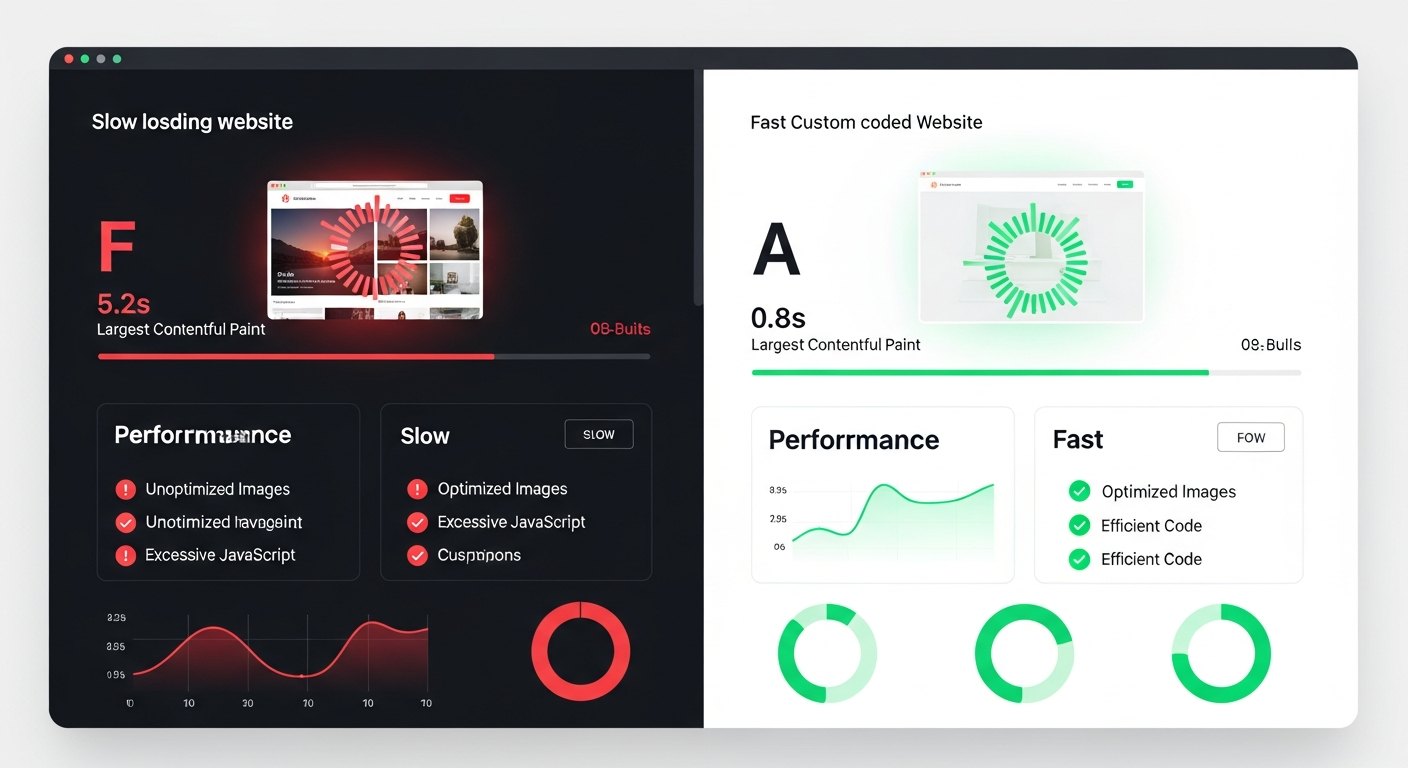
1. Speed That Actually Moves the Needle
Page speed is a ranking signal. Google uses Core Web Vitals to judge whether a page loads quickly enough to use. A PageSpeed Insights score is a lab hint, not a line that gets a site buried at 90.
Template builders often ship extra CSS, plugin scripts, and libraries the page never uses. A custom page can load only the markup, images, and scripts that page needs, which is why it is usually lighter.
Google's mobile speed study found that 53% of visits are likely to be abandoned if pages take longer than 3 seconds to load. Those are visits you do not get back.
Example:
A plumbing company can move off a template builder onto a site that loads only the code that page needs, so the mobile page is lighter and the tap-to-call button is available sooner.
2. SEO Built Into the Foundation — Not an Afterthought
Template sites give you basic SEO tools—like editable meta tags and some plugin support—but under the hood, the code is messy and bloated. This makes it harder for Google to crawl and understand your site.
Custom-coded websites let you own your SEO architecture:
- Clean, semantic HTML markup that search engines love
- Proper heading hierarchy (H1, H2, H3) structured to signal topic relevance
- Schema markup baked directly into the code (LocalBusiness, FAQ, Service, Review, etc.)
- Canonical URLs and routing that prevent duplicate content
- Auto-generated XML sitemaps that update with your site structure
- Thoughtful internal linking architecture to maximize link equity flow
Think of SEO on a template site like trying to renovate a house with a cracked foundation. You can decorate all you want, but structural issues remain.
On a custom-coded site, SEO is built into the foundation — making it easier for Google to rank you higher and for customers to find you.
Example:
A law firm can rebuild its site with semantic HTML, a clear heading structure, and schema markup so search engines can read the services and location without fighting template code.
For more on how we integrate SEO into custom code, check out our detailed SEO services.
3. Conversion-Optimized From Day One — Turning Visitors Into Customers
A local business site has one job: get the visitor to call, message, or request a quote. A custom-coded site is built around that action. The layout, the form, and the button are chosen for that path.
Conversion-focused design and development includes:
- Strategic call-to-action (CTA) placement based on heatmap and scroll data
- Progressive disclosure — showing information just when users need it
- Speed-optimized forms that load instantly and minimize friction
- Mobile-first design with thumb-friendly navigation and buttons
- Social proof (reviews, case studies, trust badges) highlighted at decision points
Unlike template builders, which offer generic “contact form widgets,” we build conversion systems tailored to your unique customer journey.
Example:
A dental practice can add a virtual smile preview and a short form so a visitor can see the service and contact the practice without hunting through the site.
Learn more about optimizing conversions with our Content & Ads services.
4. You Actually Own Your Website — No More Renting Your Digital Home
This might be the most overlooked but critical factor.
When you build on platforms like Wix or Squarespace, you’re essentially renting space on their servers. They can:
- Change pricing or restrict features at any time
- Deprecate or remove tools you rely on
- Push forced updates that break your site
- In extreme cases, shut down the platform or your account
With a custom-coded website, you own every line of code. The files live on your hosting account or server, under your control. You can move, modify, or expand your site without asking anyone’s permission.
This turns your website from a monthly subscription expense into a digital asset that appreciates in value over time.
Insight:
Owning your site also means owning your data, customer interactions, and SEO equity — all critical for sustained growth.
5. Security Without the Plugin Headaches
WordPress sites are a common target because an outdated plugin is a frequent way in. A long list of plugins means more updates, more conflicts, and more code you did not write.
Custom-coded sites drastically reduce the attack surface:
- No third-party plugins means fewer vulnerabilities
- Static content or serverless functions reduce database attack risks like SQL injection
- No admin panels means no brute force login attempts
- Modern hosting providers include SSL, DDoS protection, and edge caching by default
For local businesses handling customer information, appointments, or payments, this is more than a “nice to have” — it’s a business imperative.
6. Unlimited Customization — If You Can Dream It, We Can Build It
Every template builder hits a brick wall when it comes to complex or unique features.
Want a custom quote form, a dynamic pricing calculator, or an AI-powered intake form? You’ll likely be told:
- “That’s not possible on our platform.”
- “You need to pay for a premium plugin.”
- “You have to compromise on your vision.”
Get a FREE website that dominates Google
Built by AI in minutes — real photos, local SEO done right, live preview texted to your phone. No card needed.
Custom code removes these limitations completely.
Features a custom site can include:
- A roofing company’s real-time project tracker clients can access anytime to check job status
- A restaurant’s dynamic menu system updating availability and pricing in real-time
- A law firm’s AI-powered lead qualification form that collects the facts an attorney needs before a call
- A dental practice’s virtual smile preview tool that lets a visitor see the service before they get in touch
These custom features aren’t “nice extras.” They’re competitive advantages that template users simply can’t replicate.
7. Future-Proof Architecture — Ready for Tomorrow’s Web
The digital landscape is evolving faster than ever:
- Google’s AI Overviews are reshaping search
- Core Web Vitals are a ranking signal
- Mobile-first indexing is standard
- AI chatbots have become expected
- Voice search optimization is crucial for local SEO
Template builders react slowly — if at all — forcing you to wait for updates, hoping they prioritize your needs, and praying nothing breaks your site in the process.
Custom-coded websites can adapt immediately:
- New Google requirements? Code updated the same day.
- AI integrations? Built in and deployed within days.
- Conversion optimizations? Rolled out quickly with no platform limitations.
This agility keeps you ahead of the curve and your competitors.
What It Costs
Template platform fees, plugins, and repairs add up over time. A Rank Me Higher site is a free build and $99/mo when it is live. See the plans on our pricing page.
Is Your Business Ready for a Custom-Coded Website?
Custom code isn’t for every business. If you’re a hobby blogger posting once a month, a template might be fine.
But if any of the following applies, it’s time to make the switch:
- You depend on local search to attract new customers
- Your website loads slowly, and you’ve tried fixes without success
- You’re paying for basic features through multiple plugins
- Your competitor’s website looks and performs better than yours
- You want custom features and functionality your current platform can’t deliver
- You’re tired of your site breaking after every update or plugin install
- You want to build a digital asset, not rent one
If you’re nodding to any of these, a custom-coded website is worth a look.
What the Custom Build Process Looks Like at Rank Me Higher
Switching to a custom-coded website doesn’t have to be overwhelming. Here’s how we make it simple and efficient:
1. Contact
We start by understanding your business, customers, and goals, so the site is planned around the calls and forms you want.
Contact us
2. Strategy & Wireframing
We map out every page, CTA, and conversion point, creating wireframes that focus on user experience and SEO. This step aligns expectations and streamlines development.
3. Design & Development
Our expert team builds your site using React, TypeScript, and other modern technologies. Every element is coded for speed, accessibility, and conversion.
4. SEO Integration
From day one, schema markup, meta tags, and technical SEO are baked into the site. We ensure your site is search-engine-ready at launch. Learn more about our SEO services.
5. Launch & Continuous Optimization
We deploy your site with zero downtime, monitor performance, and continuously optimize based on analytics and user feedback.
Typical timeline: About 10 business days from kickoff to launch — no months-long delays or scope creep.
The Bottom Line: Your Website Is Your Best Employee in 2026
In 2026, your website isn’t just a digital brochure. It’s your hardest-working employee — working 24/7, never taking a day off, and talking to every potential customer who searches for your services.
So ask yourself:
- Do you want that employee to be average (template)?
- Or exceptional (custom-coded)?
A custom-coded site is built to give a local business:
- A lighter page that loads only what that page needs
- Layout and forms built around the action you want
- Markup search engines can read
- No plugin update cycle that can break the site
- Ownership of the code and the content
The template era served its purpose. In 2026, custom code is how a local business can own a faster, clearer site.
Ready to see what a custom-coded website can do for your business? Contact us.
FAQ: Custom-Coded Websites in 2026
What is the difference between a custom-coded website and a template website?
A custom-coded website is built from scratch using programming languages tailored to your business needs, while a template website uses pre-made themes and drag-and-drop tools that many other sites share. Custom-coded sites offer better speed, SEO, and customization.
How much does a custom-coded website cost compared to templates?
A Rank Me Higher site is a free build and $99/mo when it is live. Template fees, plugins, and repairs are what add up on a rented platform. See pricing.
Will a custom-coded website improve my Google rankings?
Yes. Custom sites are optimized with clean code, proper schema markup, fast load times, and SEO best practices, all of which are critical ranking factors in 2026.
How long does it take to build a custom-coded website?
At Rank Me Higher, the average timeline is about 10 business days from kickoff to launch, including design, development, and SEO integration.
Can I add new features to my custom-coded website later?
Absolutely. Custom code is flexible and scalable, allowing you to add or modify features as your business grows without platform limitations.
People Also Read
- How to Rank #1 on Google Maps
- Local SEO vs Organic SEO: What’s Best for Your Business?
- The Ultimate Guide to Website Conversion Optimization
By embracing custom-coded web applications in 2026, you’re not just building a website — you’re building a powerhouse digital asset engineered to grow your business, outrank competitors, and convert visitors into loyal customers. Don’t settle for “good enough” when excellence is within reach.
Ernest
Rank Me Higher